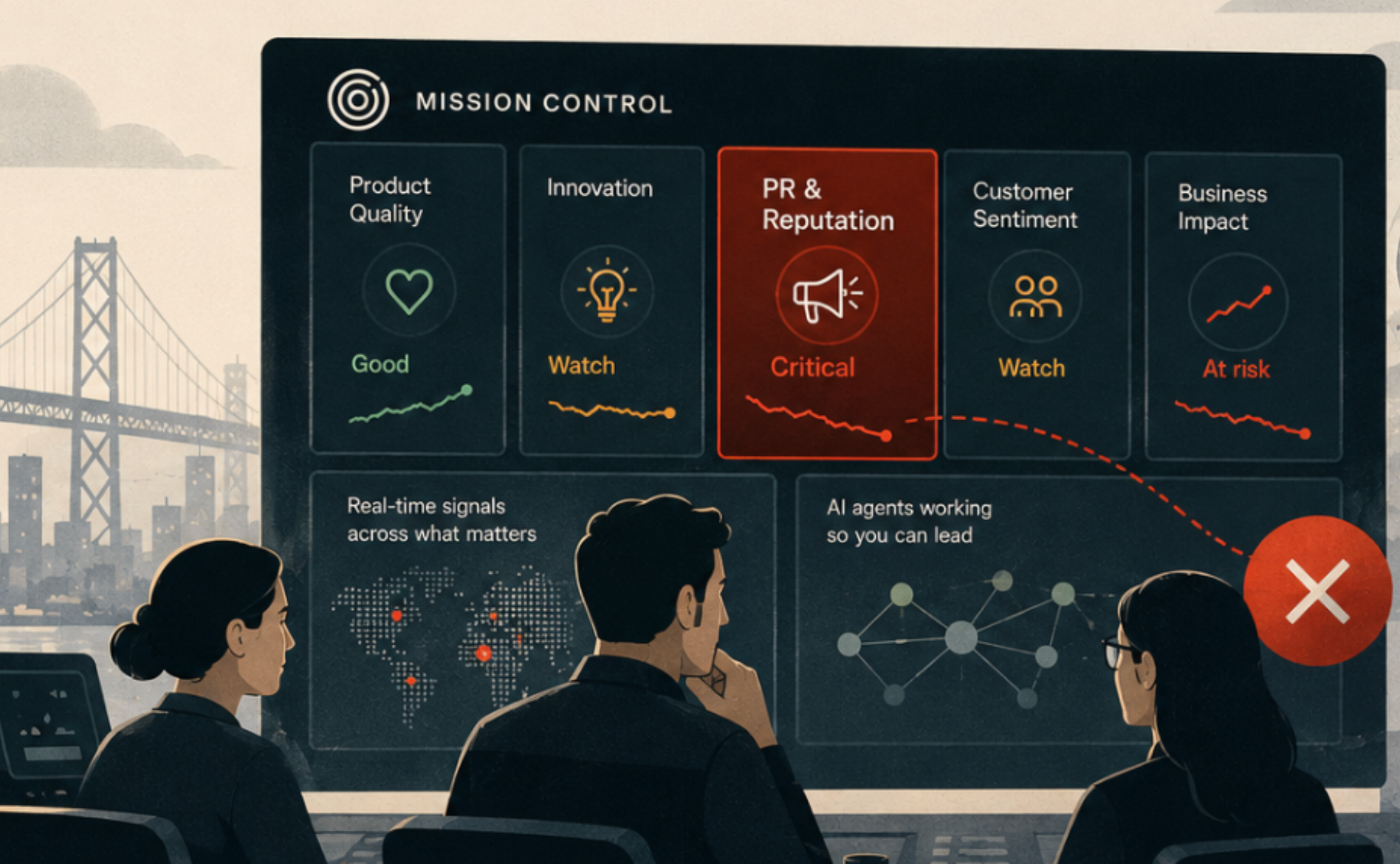
Every company ever built traces back to a single idea: a problem worth solving and a customer worth serving. The systems we built to pursue that mission — the meetings, the hierarchies, the quarterly cadences — did what they were designed to do. But somewhere along the way, we got lost in the machinery. Coordination consumed the time that should have gone to innovation.
The structure we inherited
The organizational structures we inherited were rational responses to real constraints. Information moved slowly. Coordination across large groups was genuinely hard. Hierarchy existed because signal had to travel through layers: someone had to translate strategy into action, action into status, status back up into strategy. Meetings existed because there was no other way to synchronize. OKRs existed because there was no real-time view of what was working.
The calendar became the operating system because it was the only one available. It was the right answer for its time. And for a long time, it held.
Every operating model has a natural lifespan. Not because it failed, but because the conditions that made it work eventually change. Three forces have now converged that are doing exactly that, quietly dissolving the constraints that made the old structure necessary. Mission Control is the unlock.
Three forces changing the rules
Signal is now actionable before the next meeting.
The first is the velocity of information. Reputations that once took months to build or damage now shift in hours. A product quality issue that would have surfaced in a quarterly review now surfaces in real time: in support tickets, in social sentiment, in usage patterns that change overnight. The organization that waits for the next scheduled sync to learn something important is already behind.
The gap between deciding and doing just collapsed.
The second is autonomous agents. Software no longer just assists human work. It executes it, continuously, at a scale no organization has operated at before. Today, a human team of two to five people can already supervise an agent factory of fifty to a hundred specialized agents running end-to-end processes: product launches, customer onboarding, closing the books. Agents don't sleep. They don't wait for Monday. They identify problems, triage complexity, and resolve what can be resolved, without a meeting being called, without a calendar being touched.1
The operating model has become the constraint.
The third is the structure. For decades, the coordination layer was an unavoidable tax, the cost of keeping a large organization aligned. It was invisible because there was no alternative. The first two forces have changed that. When information arrives faster than your meeting cadence, the meeting becomes the delay. When agents can execute continuously, the handoffs between humans become the friction. The inherited structure does not disappear. It becomes visible as the thing slowing the mission down.
What Mission Control looks like
What emerges from these three forces is not just a better set of tools. It is a fundamentally different operating model, one organized around the mission rather than around the coordination layer that once served it. Call it Mission Control.
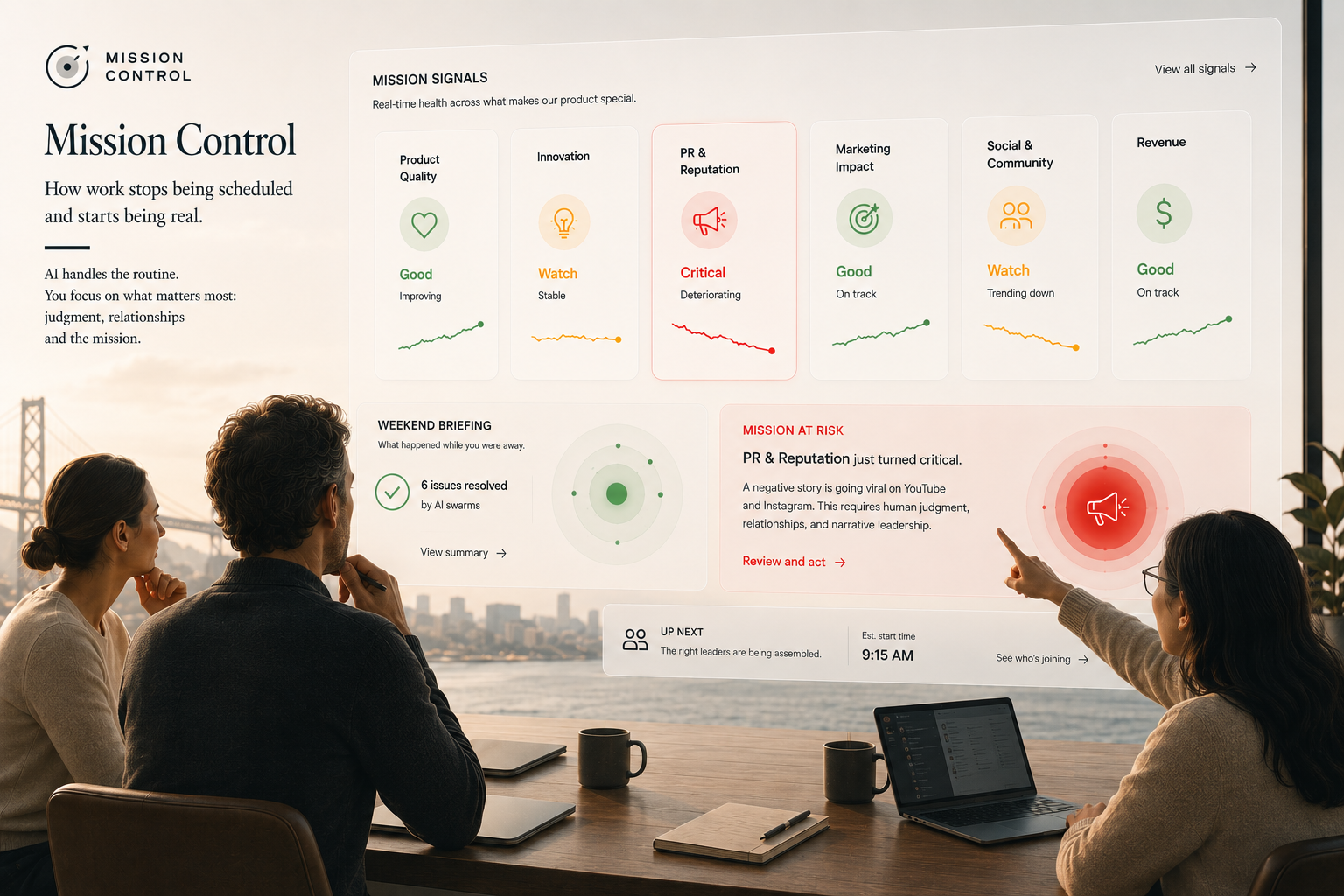
Imagine sitting down on a Monday morning and opening a single view. Not a stack of dashboards built two years ago by someone who has since left. Not a scroll of messages and a deck assembled at midnight. One view. A heatmap across every dimension that makes a product or service genuinely special: product quality, innovation, public relations, marketing, social, community, revenue.
It is not a data dump. It is a set of signals. Green, yellow, red. The system is not reporting to you so much as orienting you, surfacing where the mission is healthy, where it is under pressure, and where it needs you. You are no longer hunting for the picture. The picture finds you.
The agenda used to determine the day. Now the day determines the agenda.
The weekend that worked without you
On Friday, product quality was red. This Monday, it is green.
Over the weekend, an agent swarm addressed the problem: identified it, triaged it, worked it, resolved it. No one scheduled that. No one convened a war room. The work happened while the leaders slept, and the morning briefing does not just show what is wrong today. It shows what was already handled, so that judgment can be reserved for what could not be.
That last part matters, because not everything could be.
The problem that needed a human, and tools that didn't exist yet
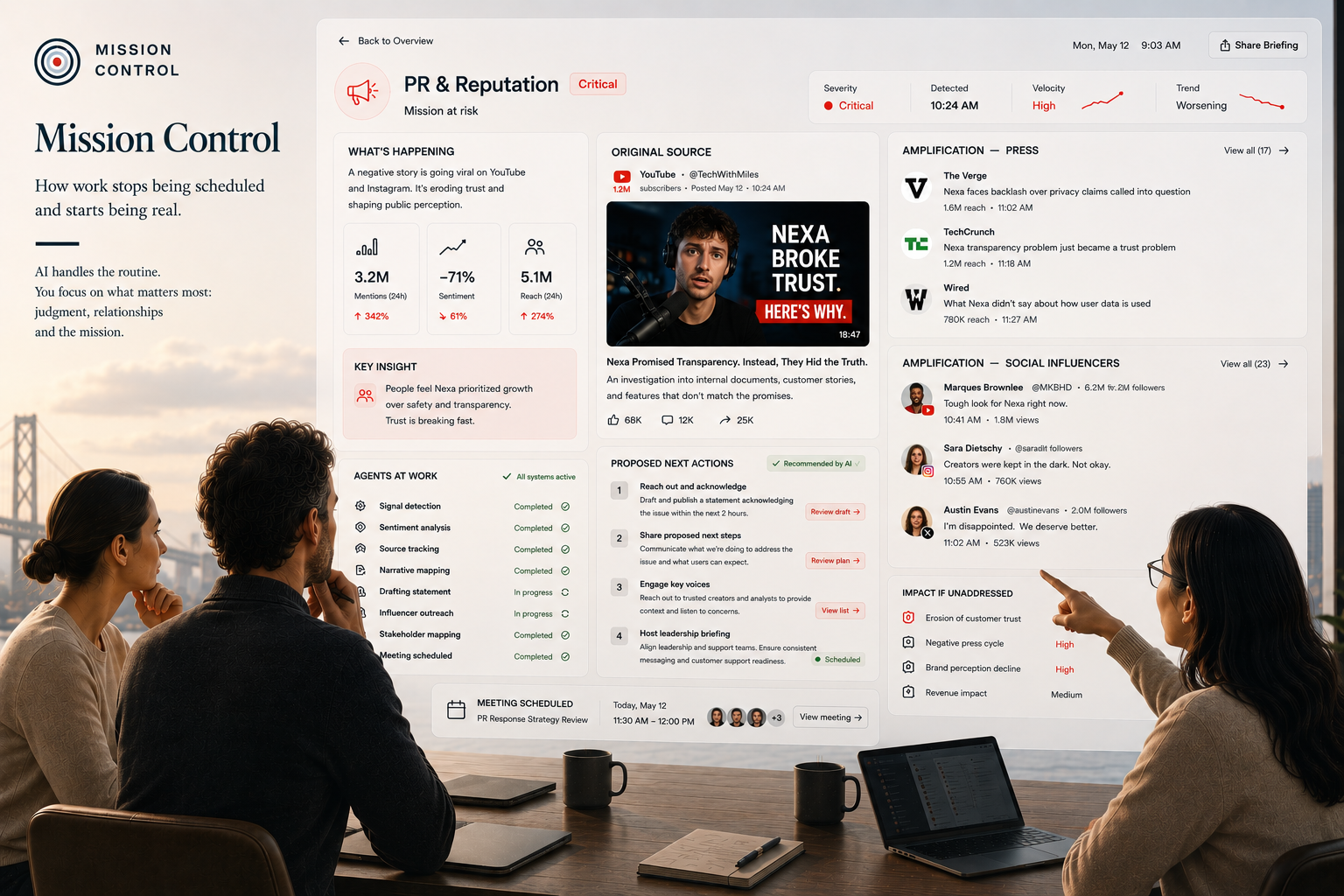
Sometime Saturday, a negative press story surfaced and went viral. On the heatmap, public relations has just turned red. The mission is under real threat, and this is not a problem an agent swarm can close on its own. It needs judgment. It needs relationships. It needs narrative craft and someone willing to be accountable for the call.
But something else happened too. Because this crisis was unlike anything the organization had faced before (a specific combination of viral momentum, platform dynamics, and message framing that had never converged in quite this way), the system didn't just assemble the right people. It built the right tools. In real time, purpose-built for this exact problem: sentiment trackers calibrated to the specific story arc, response frameworks tuned to the platforms where the narrative was spreading, briefing documents assembled from every piece of relevant organizational history. The swarm didn't arrive empty-handed. It arrived equipped.
Intelligence that proposes, humans that decide
Before the first leader walked into the room, the system had already done something more. It modeled the problem space, running parallel simulations across multiple response scenarios, each pressure-tested against historical outcomes, brand values, platform dynamics, and stakeholder sensitivities. Not one path forward. Several. Each with a projected outcome, a risk profile, and a reasoning trail.
Then it proposed a next best action. Ranked. Reasoned. Ready to be challenged.
The leaders didn't arrive at a blank whiteboard. They arrived at a briefing that already knew what the best move probably was, and could show its work. Their job was not to generate options from scratch. It was to apply the judgment, relationships, and accountability that no model can carry: to review, to pressure-test, to decide.
This is the shift that matters most. Mission Control doesn't replace the human call. It changes what the human is being asked to do when they make it. The model moves from humans using AI as a tool to something more reciprocal: a collaboration between human judgment and machine intelligence. The system reasons. It proposes. It shows its work. And then it defers to the humans in the room. Not a dashboard. An intelligence with a point of view.
The calendars had already reorganized. The right leaders (the ones who own this, who carry the credibility and the context) were assembled, because the system knows who they are and what the problem actually is. Nobody had to call the meeting. The meeting called itself.
Humans above the loop
There is a useful distinction emerging in how organizations think about the relationship between humans and agents. "Humans in the loop" means agents do pieces of a process and pass to humans. "Humans above the loop" means agent teams handle most of the work, and humans provide judgment on top. Mission Control is the organizational expression of that second model. Not humans managing tasks. Humans orienting purpose.
Stanford's research points to where this leads for individual leaders: as agents take on more of the information-processing work, the most valued human competencies shift toward interpersonal skills, organizational judgment, and decision-making. The skills that cannot be automated are precisely the skills that get crowded out by the calendar. Mission Control gives them back.2
The return, not the removal
Here is the part that is easy to misread. This is not a story about management disappearing.
Many leaders became leaders because they first excelled as individual contributors. They were exceptional at the craft, and the reward for that excellence was to be promoted away from it, into coordination, into the calendar, into the machinery of keeping everyone aligned. What the mission-control model removes is not the manager. It removes the administrative overhead that made so much of management feel necessary in the first place.
Take that overhead away and something quietly profound happens: the leader gets to contribute again. The leader who spent Tuesday in a status meeting can spend Tuesday with a customer instead, learning an insight that no dashboard will ever surface. The crisis on the heatmap does not get resolved by someone skilled at running an efficient standup. It gets resolved by someone who understands narrative, stakeholders, and the weight of a decision. The model gives that person their judgment back. This is a return to something truer, not a disruption of it.
This is not a story about management disappearing. It is a story about management finally having room to lead.
The point
The future of work is not a future with fewer people in it. It is a future where the mission finally runs the organization, instead of the organization running in spite of itself.
The calendar told us what the day would be. Mission Control asks a better question: what does the mission need from us, right now? That is not a smaller job. It is the job, finally unburdened.
The mission was always there. The agentic age just built the control room.
Part 2 will explore how organizations can get started with Mission Control, the signals worth tracking first, and how to begin making the shift to a mission-driven operating model.